For Practitioners

InkWell replaces nothing. It's where your assignments go to survive the week.

You hold the protocol. The worksheet, the activity schedule, the thought record, the between-session practice: that's your clinical work, and InkWell doesn't touch it.

What InkWell does is carry it. A worksheet is a snapshot that dies in the glovebox. A journal is a trajectory. When the between-session work lives in the same place a client already writes, it gets done, and you get to see that it got done, on the client's terms.

The Case

Why a journal beats a worksheet for between-session work.

Adherence

InkWell lives on the client's phone. They can type an entry, or just talk and let voice capture turn it into clean text in the moment, not at the end of a long day from memory.

Visibility

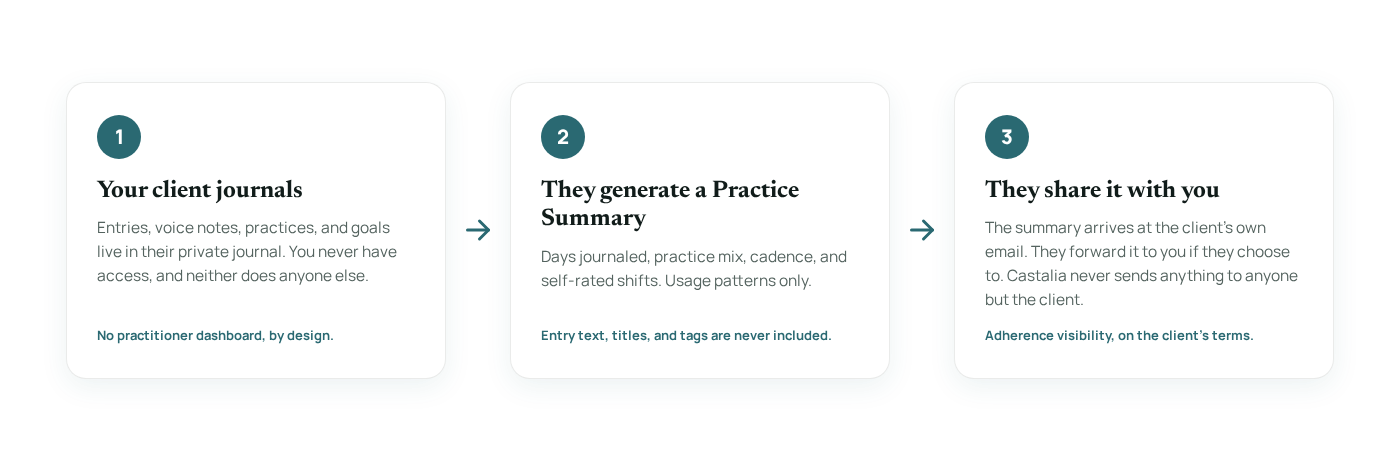
A client-generated Practice Summary shows you the pattern of practice: days journaled, practice mix, cadence. Enough to see adherence, never the content of an entry.

Continuity

Entries persist for the full arc of care. A client can look back at where they were three months ago in their own words, and so can your work together.

One tool

Activity logs, structured reflection, gratitude practice, values-based goals: different assignments, one app the client already opens. Nothing new to teach each time.

Adherence, Not Surveillance

The Practice Summary is your client's to share, on their own terms.

Journaling honesty dies under observation, so InkWell has no practitioner dashboard and no back door. The client generates a Practice Summary inside the app, receives it at their own email address, and forwards it to you if they choose to. InkWell never sends anything to anyone but the client.

It's built from usage patterns only. Entry text, titles, and tag labels are never included, so there's nothing in it that breaks the privacy of the page.

What a Practice Summary shows you

  • Days journaled and current cadence across 7, 30, or 90 days
  • Practice mix: which practices were used, and how often
  • Writing rhythm: when entries happen, and word-count trend
  • Goal progress on the client's values-based WISH plan
  • Never entry text, titles, or tags. Usage patterns only.
Use Plans

Ready-to-hand plans built on features that already exist.

Each one-pager maps a common between-session assignment onto InkWell's existing tools, with a weekly structure, what the Practice Summary will show you, and a clear scope line. Print it, or send it with your referral.

Low mood & behavioral activation

For clients doing BA, activity scheduling, or thought-record work

  • Daily quick-capture activity log with InkBlot
  • Reframe as a structured thought-record companion
  • Weekly rotation through five research-cited gratitude practices
  • Optional FeelCheck before/after ratings to notice shifts
Download the one-pager

Anxious thinking & worry

For clients working on worry containment and perspective-taking

  • Sprint: a timed, contained daily worry window
  • Reframe for looking at a hard moment from a different angle
  • Voice capture for in-the-moment worries, hands-free
  • Optional FeelCheck before/after ratings to notice shifts
Download the one-pager

Running CBT-I? Clients use InkWell for wind-down journaling alongside CBT-I. More plans are coming; if there's an assignment you'd like mapped, tell us.

Scope, Stated Plainly

What InkWell is not.

Not crisis care. InkWell is not for emergencies and is no substitute for crisis services or your clinical judgment.
Not treatment. InkWell is a wellness journaling tool. It doesn't diagnose, treat, or replace therapy. The protocol is yours.
Not a medical record. A Practice Summary is a client-shared snapshot of usage patterns, not documentation of care.

Getting Started

The free version is complete, so recommending it never costs your client anything.

Every capture mode, the full gratitude rotation, the values-based goal flow, and the Practice Summary are all free, on web, iOS, and Android. Clients who want the deeper AI reflection layer can upgrade, but nothing you assign depends on it.